
A practical guide for business owners and marketers after Google retired FAQ rich results in Search. What still matters in visible Q&A content, when to drop or keep FAQPage markup, and which Organization and LocalBusiness fields to put on the pages that describe your company.
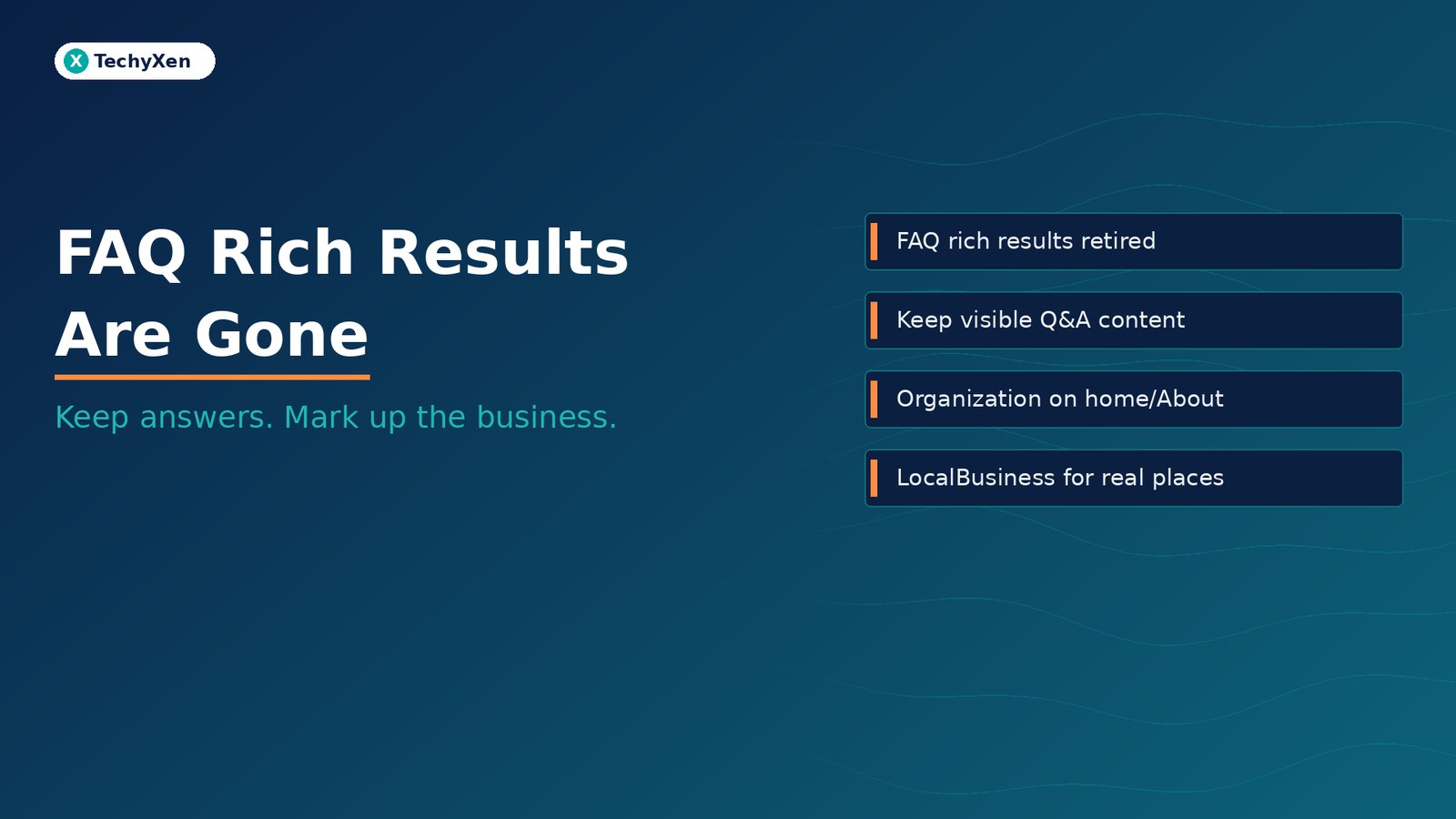
FAQ rich results no longer appear in Google Search — as of 7 May 2026. Google’s Search Central changelog recorded the deprecation on 8 May 2026 and removed the FAQ rich-result documentation on 15 June 2026. That does not mean “delete every question on your site.” It means stop treating FAQ schema as a ranking or CTR shortcut, keep answers that help buyers, and put accurate Organization and LocalBusiness markup on the pages that describe your business.
What Google actually changed about FAQ rich results
For years, many sites added FAQPage JSON-LD so expandable questions could appear under blue links. Google has now shut that Search appearance off for everyone.
From Google’s own documentation updates:
- 7 May 2026 — FAQ rich results stop appearing in Google Search.
- 8 May 2026 — deprecation notice added to the FAQ structured-data docs.
- 15 June 2026 — FAQ rich-result documentation removed because the feature is no longer shown.
- June–August 2026 — Search Console FAQ rich-result reporting, Rich Results Test support, and API fields for that appearance are phased out on Google’s published schedule.
Google has said you can leave FAQ structured data in place if you want — other systems may still read it — but it will not recreate the old Google Search rich result. If the only reason the markup existed was that dropdown in the SERP, it has done its job and can go.
“FAQ rich results are gone from Google Search. Keep real answers on the page; do not keep spam FAQ blocks just to feed old markup habits.”
Keep useful answers — remove FAQ blocks that only existed for schema
Visible Q&A still helps people decide: pricing boundaries, what is included, turnaround, who you serve, how onboarding works. That content belongs in plain HTML — headings and paragraphs or a real accordion people can open.
Audit every FAQ section with one question: Would we keep this if Google had never shown FAQ rich results?
- Keep questions buyers actually ask before they enquire, with answers that match what sales says on calls.
- Rewrite thin keyword-stuffed Q&As that never appear in proposals or sales scripts.
- Delete templated blocks cloned across every service page with the same ten questions and no page-specific truth.
- Do not hide answers that only exist inside JSON-LD. Google’s general structured-data guidelines require markup to match content visible to readers.
If you remove FAQPage markup, leave the useful visible FAQ unless the content itself was junk. Markup is not the product — the answer is.
What Organization schema is for now
Google’s Organization structured data guide says adding organization details on your home page or a single about page helps Google understand administrative facts and disambiguate your company. Some properties work behind the scenes; others can influence elements such as which logo appears in Search and knowledge-panel style surfaces. There are no required properties — add what honestly applies.
Practical placement:
- Put Organization (or a more specific subtype) on the homepage or About page — not necessarily on every URL.
- Use the most specific subtype that fits (for example
OnlineStorefor a store, not a vague parent type when a child fits better). - Match
name/alternateNameto how the site presents the brand. - Provide a crawlable, indexable
logo(Google notes a minimum 112×112 image and plain-background readability). - Add
url,telephone,email,address, andsameAsprofiles when they are real and consistent with what users see.
This is entity clarity work: one clear machine-readable description of who you are, aligned with the public site — not a keyword dump.
When LocalBusiness markup earns its place
Google’s LocalBusiness structured data is for businesses with a real local presence users might search for. Required fields are name and address. Recommended fields include telephone, URL, geo coordinates, opening hours, and departments when those differ from the main location.
Use the most specific LocalBusiness subtype (for example a restaurant type for a restaurant). If you have multiple types, Google documents specifying them as an array.
Important review rule from Google’s LocalBusiness docs: review and aggregateRating are recommended only for sites that capture reviews about other local businesses — not for self-serving star markup on your own homepage. Fake or self-awarded ratings risk structured-data manual actions under Google’s quality guidelines.
- Do mark real hours, phone, and address for a genuine location page.
- Do not invent a storefront address to unlock local rich results.
- Do not paste AggregateRating that does not come from visible, policy-compliant reviews.
“Organization and LocalBusiness markup only help when they match a real business page. Self-serving review stars are a liability, not a growth hack.”
Quality rules that still apply to every schema type
Google’s general structured data guidelines still gate rich-result eligibility. Structured-data manual actions remove rich-result eligibility; they do not by themselves remove ordinary web ranking — but spammy or misleading markup can still collide with broader spam policies.
Non-negotiables:
- Markup must represent the main, visible content of the page.
- Do not mark up hidden, irrelevant, or misleading content.
- Prefer JSON-LD (Google’s recommended format), or valid Microdata / RDFa.
- Do not block the page from Googlebot with robots.txt,
noindex, or login walls if you want the markup understood. - Validate with the Rich Results Test for types Google still supports; use URL Inspection after deploy.
- Expect days of recrawl time — markup is not an instant switch.
Also remember Google’s standing line: correct markup enables a feature; it does not guarantee the feature will show for every query.
A cleanup sequence for service and ecommerce sites
Run this once, then treat schema as maintenance — not a monthly “hack” list.
- Inventory every page emitting
FAQPage, HowTo leftovers, review aggregates, Organization, and LocalBusiness. - Separate content from markup — decide which FAQs stay as human-readable copy before you touch JSON-LD.
- Remove or stop emitting FAQPage where it only existed for Google rich results; leave it only if another consumer needs it and the visible Q&A is genuine.
- Centralize Organization on home or About with accurate name, logo, URL, contacts, and
sameAs. - Add LocalBusiness only for real locations with truthful address and hours.
- Strip self-serving AggregateRating unless you operate a review site about other businesses and meet review guidelines.
- Validate and request indexing on the updated entity pages; watch Manual Actions and rich-result reports for supported types.
Pair this with honest service pages and case studies. Assistants and search features that quote businesses still need clear claims on the page — schema is a label, not a substitute for proof.
Mark up the business you actually run
FAQ rich results were a Search appearance. Google retired them in May 2026 and removed the feature docs in June. Useful answers still belong on your site; spam FAQ blocks and SERP-only markup do not. Put accurate Organization details on home or About, use LocalBusiness only for real locations, follow Google’s visibility and quality rules, and spend the time you used to spend on FAQ schema on clearer offers, case studies, and enquiry paths instead.
TechyXen builds and maintains business websites with SEO, AEO/GEO-minded structure, and clean technical setup — including schema that matches the real business, not a template dump. If you want a structured-data cleanup alongside web development or digital marketing work, we can audit what is live, what to keep, and what to remove before the next crawl.
Web development · Digital marketing · Automation & AI · Contact · WhatsApp · Call

3 Comments
[…] Google retired FAQ rich results — keep useful answers and mark up your business instead […]
[…] Google retired FAQ rich results — keep useful answers and mark up your business instead […]
[…] Google retired FAQ rich results — keep useful answers and mark up your business instead […]