
A practical guide for founders and sales leads who want automation to filter enquiries before the call — without turning every prospect into a bot maze. What to qualify, what to keep human, and which metrics prove sales time is protected.
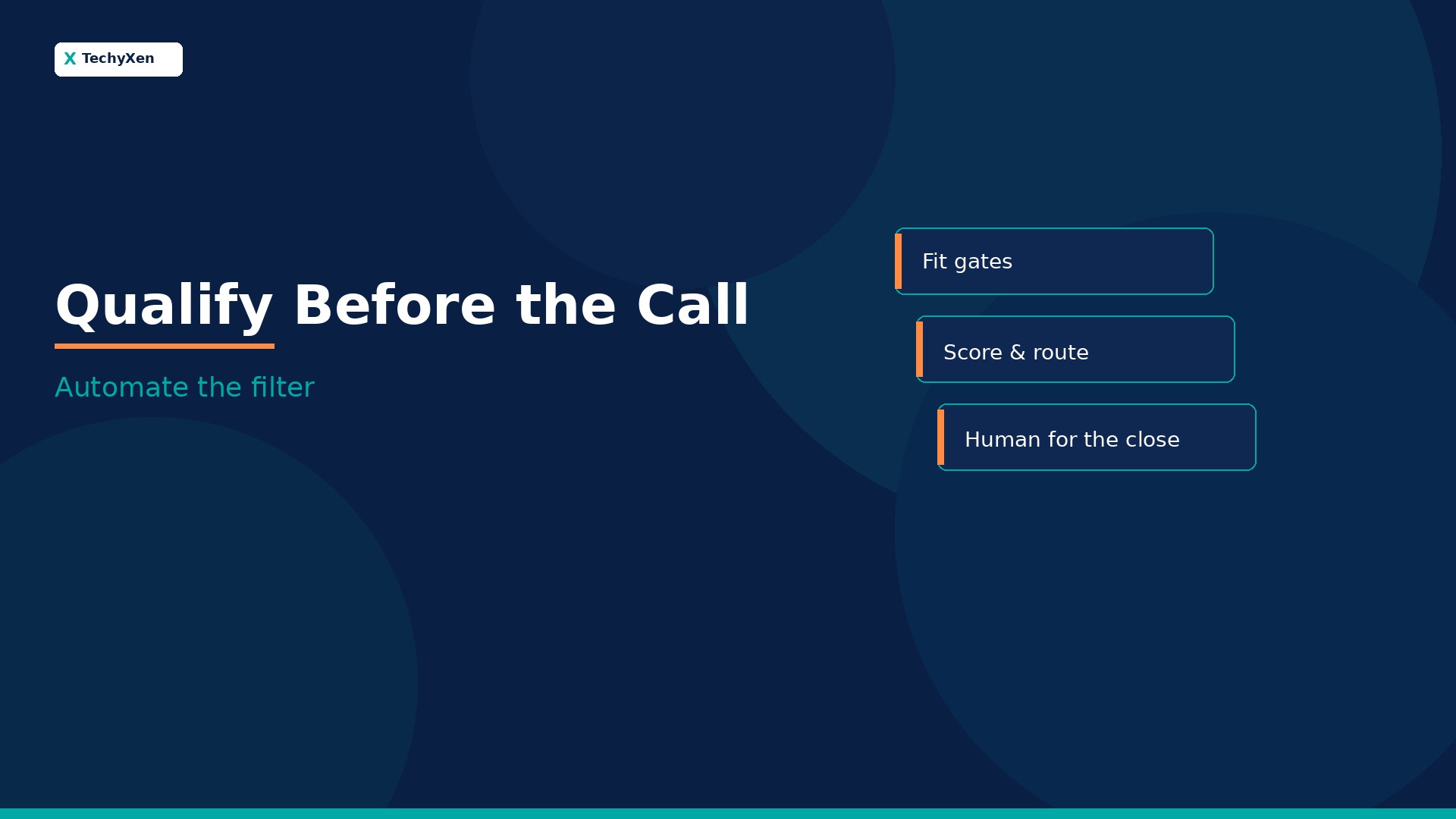
Automate the filter. Keep the relationship human. Lead qualification before the sales call means a small set of fit questions, a clear score or route, and a hard rule for when a person takes over — so your calendar fills with conversations worth having, not with tire-kickers who never answered budget, timing, or need. The bot (or form) earns its seat by protecting sales hours; it fails when it interrogates forever or hides the human path.
Why sales calendars fill with unqualified noise
Service teams rarely lack enquiries. They lack filter discipline. Ads, SEO, referrals, and chat all dump into the same inbox or CRM — and “book a call” becomes the default next step for everyone who typed an email.
That creates a familiar pattern:
- Discovery calls with no fit — Wrong service, wrong company size, or “just researching” with no timeline.
- Reps re-asking basics — Need, budget band, urgency, and decision role were never collected upstream.
- Speed theater — Instant auto-replies that schedule meetings before anyone checks whether the lead is worth the slot.
- Pipeline vanity — High booked volume, low close rate, and a team that dreads opening the calendar.
Qualification is not gatekeeping for its own sake. It is the operating rule that decides which enquiries earn a live conversation — and which get a lighter path (nurture, FAQ, or a polite no).
“A booked call is not a win if the prospect could never buy. Qualification is how you stop trading sales hours for hope.”
What a qualification gate actually is
A qualification gate is a short, written checklist that every intake path must pass before a sales slot is offered. It is not a 20-question bot. It is usually four to seven answers that map to three outcomes:
- Offer a call / demo now — Fit is clear enough; a human should engage soon.
- Nurture or async — Interested but early, thin budget signal, or missing a decision-maker — send useful content or a lighter touch, not a full discovery.
- Not a fit — Wrong product, geography you do not serve, or spam — close politely with a reason when you can.
Write the gate in plain language the whole team can use. If two staffers disagree on whether a lead “passes,” the gate is too vague. Tools come after the rules: forms, chat, or WhatsApp flows should enforce the same gates — not invent new ones per channel.
Score lightly, route clearly
Scoring helps when volume is high enough that humans cannot read every row. Keep it light:
- Few weighted signals — e.g. service match, company type/size band, timeline, budget band, and whether a decision role is named. Avoid scoring “enthusiasm” from emoji or message length.
- Transparent bands — Hot / warm / cold (or A / B / C) with one sentence each on what happens next.
- Routing rules — Who owns hot leads; who owns niche verticals; what happens after hours. A score without an owner is just a number.
- Override — Humans can promote or demote. Automation proposes; people correct. Log overrides so you can fix the gate later.
Heavy lead-scoring models fail SMBs when nobody trusts the math. A simple band plus a named owner beats a black-box score nobody reviews.
“Score to decide the next step — not to decorate the CRM. If the band does not change who replies or what they offer, delete the score.”
What automation may ask — and what must escalate
Automation is good at collecting facts. It is bad at judgment, negotiation, and trust repair. Draw the line explicitly:
Safe for bots / forms to ask
- What service or problem are they exploring?
- Rough company size or segment (bands, not an interrogation).
- Timeline (now / this quarter / researching).
- Preferred contact channel and best window for a call.
- Consent and basic contact details.
Must escalate to a human
- Price negotiation, custom scope, or “can you match competitor X?”
- Complaints, refunds, or anything emotional.
- Ambiguous fit — the answers conflict or the prospect pushes back on the questions.
- High-ticket or strategic deals where the relationship is the product.
- Any turn where the bot would need to invent policy or promise a delivery date.
Design a visible exit: “Talk to a person” that preserves answers already given. A qualifier that traps people in loops does not save sales time — it burns brand trust before the call even starts.
Metrics that prove sales time is protected
Skip vanity “leads this month” charts. Track a short scoreboard tied to qualification quality:
- Qualified-to-booked rate — Share of leads that passed the gate and received a confirmed slot.
- Sales hours on unqualified calls — Meetings that should have been filtered (wrong fit, no budget signal, pure research). Count them for two weeks; that is your waste baseline.
- Show rate on qualified vs unqualified — If “everyone gets a calendar link” show rates are low, the filter is too open.
- Time from pass-gate to first human touch — Qualification should speed the good leads, not park them.
- Override rate — How often humans reverse the bot/form decision. High overrides mean the gate or scoring needs a rewrite.
- Close rate by band — Do hot leads actually close more often than warm? If not, your bands are fiction.
Use your own quiet week and busy week as baselines. Do not paste industry “average lead score” numbers you cannot verify. If sales hours on unqualified calls stay high, tighten the gate — do not buy another chatbot skin.
A one-week checklist before you automate scoring
Before you wire AI qualification or a complex scoring plugin:
- List the last 15–20 sales calls. Mark each: should have been offered / should have been nurtured / should have been declined — and why.
- Write the four-to-seven gate questions and the three outcomes (call / nurture / no) in one page everyone can see.
- Define hot / warm / cold in one sentence each, plus who owns each band during staffed hours.
- List escalate-now triggers (negotiation, complaint, ambiguity, high ticket).
- Pick one intake path (form or chat) and enforce the gate for 7–14 days before you expand channels.
- Instrument the six metrics above; name who reviews them weekly.
- Only then choose automation that can ask the questions, apply the band, route to an owner, and hand off with context — reject demos that only show a chatty FAQ.
If the pilot cuts unqualified meeting hours without hiding the human path, expand. If reps still re-ask everything on the call, the gate is unfinished — not “under-automated.”
Build for what comes next
Lead qualification pays when it protects sales calendars and still feels respectful to the buyer. Automate the filter: fit questions, light scoring, clear routing. Keep the relationship human: negotiation, exceptions, and the close. Start with the gate and the scoreboard — then choose forms, chat, or AI assistants that enforce them.
TechyXen helps startups and SMBs design lead qualification, routing, and AI automation around real sales ops — with clear scopes, honest handoffs, and no bot mazes.
Automation & AI · Web development · Contact · WhatsApp · Call

1 Comment
[…] Lead qualification before the sales call […]