
A practical guide for founders and ops leads putting AI on company knowledge — when Retrieval-Augmented Generation (answers grounded in your FAQ, SOPs, proposals, and policies) beats fine-tuning a custom chatbot, how to prepare docs, and which metrics prove the answers are safe to ship.
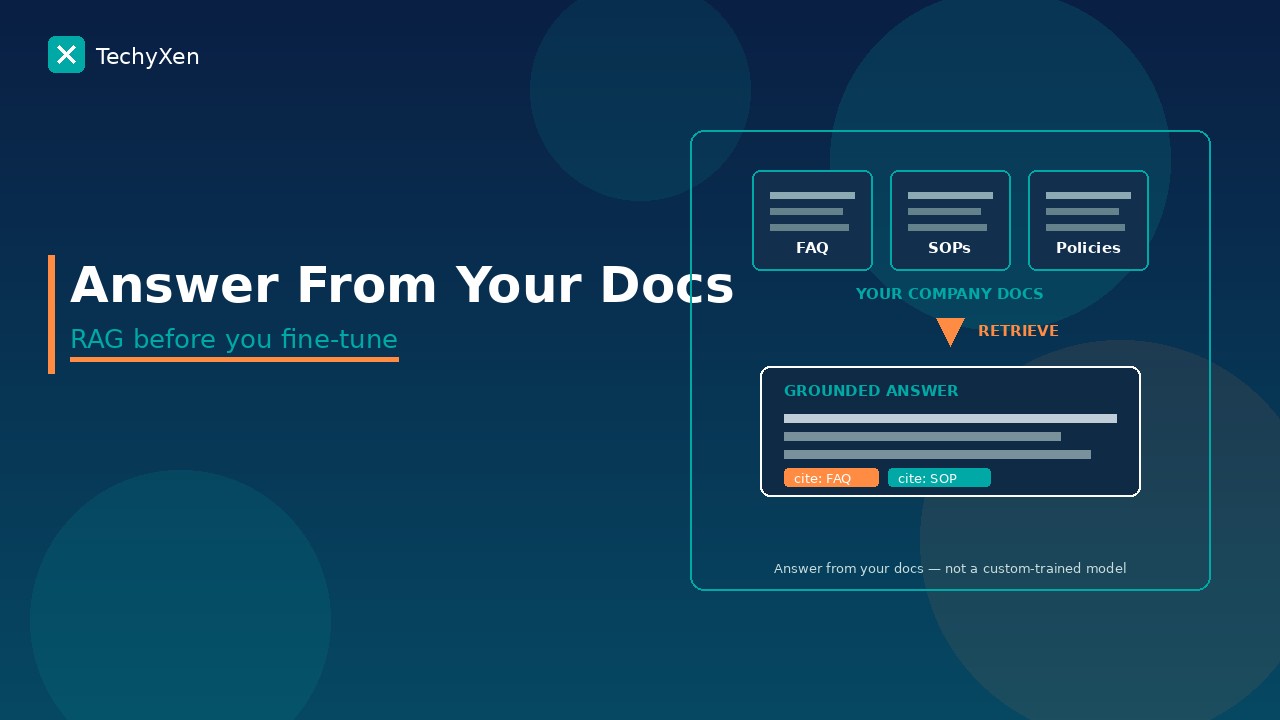
If your AI must answer from your company’s own documents, start with RAG — retrieve the relevant chunks, then generate an answer that cites them — before you pay to fine-tune a custom model. Fine-tuning changes how a model sounds or behaves; it does not magically install your latest price list, refund policy, or proposal template. For service SMBs, the durable pattern is clean docs + retrieval + clear escalation — not a private model you retrain every time ops changes a paragraph.
What RAG is — and what fine-tuning actually changes
Two different jobs get sold under the same “custom AI” label. Separate them before you buy:
- RAG (Retrieval-Augmented Generation) — At answer time, the system searches your approved knowledge (FAQ, SOPs, policies, proposal templates), pulls the closest passages, and asks the model to answer using those passages, ideally with citations. Update a doc and the next answer can reflect it without retraining.
- Fine-tuning / custom training — You update model weights on examples so the model follows a style, format, or narrow skill. Useful for tone, structured outputs, or domain jargon. Weak at staying current when your living documents change weekly.
- Prompt-only / system prompt — Instructions and a few examples in the prompt. Fine for routing and short scripts. Breaks when the truth lives across dozens of pages the model never sees.
- Hybrid — Light fine-tune or strong system prompt for voice and tool use, plus RAG for facts. Common in mature stacks; still starts with retrieval for knowledge.
If the buyer brief says “train a chatbot on our website,” ask which job they mean: grounded answers from docs, brand voice, or workflow automation. Those are different builds.
“Fine-tuning changes how the model behaves. RAG changes what it is allowed to know right now.”
When RAG is enough for a service SMB
RAG is usually the right first system when:
- Truth lives in documents — Hours, packages, SLAs, onboarding checklists, warranty language, “how we deliver X.”
- Content changes often — Price sheets, seasonal offers, new service lines. You want a file update, not a training run.
- You need citations — Sales and support must show which SOP or FAQ the answer came from.
- Volume is FAQ + intake, not novel strategy — Most tickets and website chats repeat. Retrieval handles repetition well.
- Risk tolerance is low — Invented policy or pricing is more expensive than a slower “I don’t know — here’s a human.”
For website help, helpdesk macros, and WhatsApp AI that must stay honest about your offers, RAG-first is the default. Fit it into an AI upgrade path (audit → knowledge → assistants) without pretending every business needs a private fine-tuned model on day one.
When fine-tune or prompt-only fails
Fine-tuning fails as a knowledge strategy when the “training set” is really a folder of PDFs that will be outdated next month. The model memorizes patterns from examples; it does not subscribe to your Drive. Prompt-only fails when you paste half a handbook into the system prompt and hope the model never invents the other half.
Watch for these failure modes:
- Stale certainty — Confident answers from last quarter’s pricing or an old cancellation clause.
- No source trail — Agent or customer cannot see which doc was used; disputes become “the bot said.”
- Overfit demos — Looks perfect on five scripted questions; collapses on the sixth phrasing of the same intent.
- Hidden cost — Retraining, eval sets, and versioning for every SOP edit — when a doc publish + re-index would have been enough.
Reserve fine-tuning for voice, classification, or tool-calling habits after RAG already grounds the facts. Do not buy “custom trained” as a synonym for “read our PDFs.”
“If the answer must match yesterday’s policy edit, retrieval beats a retrain.”
How to prepare docs so retrieval can work
RAG quality is mostly knowledge hygiene. Before you pick a vendor, clean the corpus:
- Canonical owners — One living FAQ, one SOP set, one policy set. Kill duplicate PDFs with conflicting numbers.
- Chunkable structure — Short sections with clear headings. One answer per section beats a 40-page essay.
- Metadata — Title, audience (customer vs internal), effective date, and “do not cite externally” flags.
- Freshness rules — Who updates price and SLA pages; what “expired” means; how re-index runs after publish.
- Exclusion list — Drafts, old proposals with client names, internal HR notes — never in the public or customer-facing index.
- Gold questions — 20–40 real questions from chat, email, and WhatsApp with the approved answer and source doc. That becomes your eval set.
If two PDFs disagree on a refund window, the model will eventually pick one at random. Fix the conflict in ops first; then index.
What “hallucination risk” means operationally
Hallucination is not a vibe. For a service business it is a concrete failure: the assistant states a price, deadline, entitlement, or process that is not in your approved sources — and someone acts on it. Operationally you care about:
- Ungrounded claims — Answer content not supported by retrieved passages.
- Wrong source — Retrieved an internal draft or expired policy and treated it as live.
- Over-complete answers — Fills gaps with plausible filler when retrieval returned nothing useful.
- Silent miss — Skips the escalation path when confidence or overlap is low.
Design the product rule in plain language: If retrieval is weak, say you are unsure, show what you found, and offer a human. That rule belongs in the assistant design — website widget, helpdesk, or WhatsApp — before go-live marketing copy.
Metrics that prove grounded answers (not vanity chat volume)
Skip “messages handled” as the primary scoreboard. Track a short set that matches how you will defend answers to customers:
- Groundedness — Share of answers where every material claim maps to a retrieved passage (human or LLM-as-judge review on a sample).
- Citation present — Share of answers that show a source title or link the agent/customer can open.
- Citation correct — Spot-check: does the cited doc actually support the claim?
- Escalation rate — When retrieval is thin, does the bot hand off — and does the human get the retrieved snippets?
- Correction / reopen — Customer or agent marks the answer wrong within a defined window.
- Doc freshness lag — Time from publishing a policy change to the index reflecting it.
Run your gold-question set weekly. If groundedness drops after a content dump, fix chunking and owners — do not buy a bigger model first.
Where this fits on website, helpdesk, and WhatsApp
Same knowledge spine; different surfaces:
- Website — Chat or search that answers service FAQs with citations, then routes high-intent leads to a form or calendar — not an endless bot interrogation.
- Helpdesk — Agent assist: draft reply + sources. Human sends. Fastest trust win for many SMBs.
- WhatsApp / messaging — Short grounded replies for hours, status, and policy; hard exit to a human when the ask is exception, negotiation, or complaint.
You do not need three disconnected “AIs.” You need one approved corpus, one retrieval layer, and channel-specific handoff rules. That is an AI systems upgrade — audit the knowledge, then implement — not a chatbot skin.
Build for what comes next
Put AI on your knowledge the way you would put a junior hire on the desk: give them the right binders, tell them when to ask a senior, and measure whether their answers match the binders. RAG is that binder system. Fine-tune later if you need a sharper voice or workflow skill — after the docs and metrics are honest.
TechyXen helps startups and SMBs design website, helpdesk, and messaging AI that answers from their own documents — with clear scopes, retrieval, and human escalation — not package gimmicks.
Automation & AI · Web development · Contact · WhatsApp · Call

1 Comment
[…] When RAG beats a custom-trained chatbot […]