
A decision guide for founders and marketing leads who get WhatsApp enquiries but cannot tell which ad, organic post, or referral created the chat — and who should fix attribution before scaling spend.
If you cannot name the source of a WhatsApp chat, you cannot defend the ad budget that created it. Scaling Meta, Google, or LinkedIn spend while every enquiry lands in a raw wa.me inbox is how teams confuse “busy WhatsApp” with working campaigns.” Attribution does not need a perfect multi-touch model on day one. It needs a durable source on every chat, a CRM field sales will not overwrite, and honesty about first-touch versus last-touch. Fix that before you raise budgets.
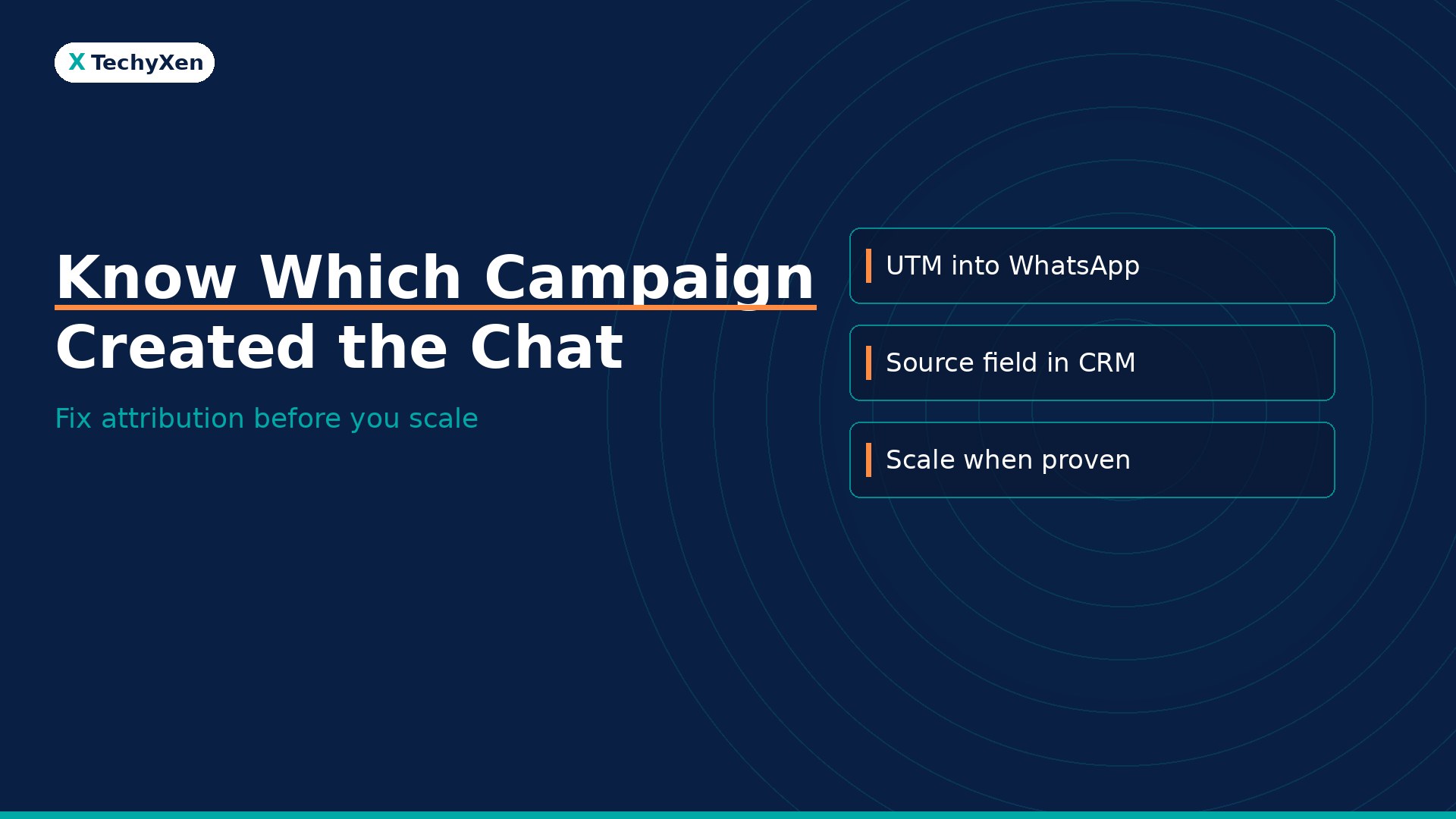
Why WhatsApp enquiries hide the campaign that created them
Website forms and landing pages usually carry UTM parameters into a CRM. WhatsApp often does not. A buyer taps a button, the chat opens, and the only “source” left is whatever a human remembers — or nothing.
That break happens for ordinary reasons:
- Raw WhatsApp links — Ads and bios use a plain
wa.meor click-to-chat URL with no campaign, ad set, or creative parameters. - Shared numbers One business number receives Meta ads, Google ads, QR codes, email signatures, and staff forwards into the same thread list.
- Staff improvisation — “How did you hear about us?” is asked inconsistently, typed freeform, or skipped when the chat is hot.
- Tool seams — Ads managers report clicks; WhatsApp shows chats; the CRM shows deals. Nothing joins the three without deliberate design.
This is a different problem from choosing website chat versus WhatsApp for first reply, and different from designing bot-to-human handoff. Here the channel already works. The ledger is blank.
“Busy WhatsApp is not proof the campaign worked. A source you can trust on the deal is.”
What good enough” attribution looks like before you scale
You do not need last-click perfection across every offline conversation. You need enough signal to decide whether to raise or cut spend. For most SMB and mid-market teams, good enough means:
- Every paid WhatsApp entry carries a source tag — Campaign (and ideally ad set / creative) encoded in the click-to-chat link or pre-filled message.
- The tag lands in a system of record CRM, helpdesk, or spreadsheet your sales lead actually opens — not only in ad platform reports.
- Organic and referral have their own lanes — Distinct links or QR codes for site CTAs, email, partners, and packaging — so paid does not absorb credit by default.
- Humans cannot silently erase the first source — Staff can add notes; they should not overwrite the original campaign field with “WhatsApp or “Inbound.”
If those four are missing, scaling ads multiplies noise. Fix the capture path first.
UTM and source tracking into WhatsApp links
Treat WhatsApp like a landing page destination: the click must carry context. Practical patterns that work without inventing a stack:
- Unique click-to-chat URLs per campaign — Separate WhatsApp links (or tracked redirects) for each major campaign. Pre-fill the first message with a short code staff and automations can parse (campaign key, not a novel).
- Tracked redirects before
wa.me— Your site or a short link captures UTM parameters, logs the hit, then opens WhatsApp. The CRM can receive the same UTMs via webhook or zapped row. - UTM discipline on the pages that open WhatsApp — If the ad lands on a page and the page’s WhatsApp button is naked, you lost the campaign at the last click. Pass source into the button URL.
- One naming convention —
utm_source/utm_medium/utm_campaign(and creative when useful) that match ad platform names so reports reconcile without a translation layer.
Do not rely on Meta or Google messaging” metrics alone. Platform-reported chats are useful; they are not a substitute for a source field on the opportunity your team closes.
“If the WhatsApp button ignores UTMs, your landing page attribution ends where the buyer’s thumb starts.”
First-touch vs last-touch — be honest about what you can claim
Founders often want one number that says “this campaign closed the deal.” Reality on WhatsApp is messier: someone may click an ad, disappear, return from a referral, then chat from a Google search.
- First-touch Which campaign first put the brand in the buyer’s path. Useful for awareness and top-of-funnel spend decisions.
- Last-touch — Which link opened the WhatsApp chat. Useful for creative and offer tests on the final click.
- Honest middle — Keep both when you can: original campaign on create, last WhatsApp entry point on the chat record. Do not collapse everything into “WhatsApp inbound.”
Pick a primary rule for budget decisions and write it down. Changing the rule every week to make a campaign look good is how attribution becomes politics.
CRM and source fields that survive the handoff
Attribution dies when the first human to touch the chat renames the source. Design the fields like infrastructure:
- Locked or protected original source Set once from the tracked link or form; staff use a separate “notes” or stated source” field for what the buyer says.
- Campaign + medium + content Enough to roll up in a report without reading every transcript.
- Chat ↔ deal linkage — The WhatsApp thread ID or contact must connect to the CRM person/deal, or closed-won will never map back to spend.
- Handoff without wipe When automation qualifies and a human takes over, the source travels with the contact. (Handoff design is a separate topic; source persistence is non-negotiable here.)
If your CRM only has a free-text “Source that defaults to WhatsApp, you do not have attribution. You have a channel label.
Failure modes that make scaling ads dangerous
Stop and fix these before you increase budgets:
- One shared
wa.meeverywhere — Ads, packaging, email, and influencers all open the same naked link. - How did you hear? as the only system — Buyers misremember; staff paraphrase; reports become folklore.
- Ad dashboards as the CRM Clicks and messaging starts look healthy while sales works a different, unlabeled inbox.
- Overwriting first source on every reply — Last staff edit becomes Instagram” because that was todays guess.
- Scaling the creative, not the capture — New ads reuse the same untracked WhatsApp CTA, so every test pollutes the same bucket.
None of these need a new agency retainer to fix. They need link hygiene, one CRM field policy, and a weekly check that new campaigns ship with tracked WhatsApp entry points.
Metrics that prove attribution is good enough to scale
Use operational checks, not vanity charts:
- Tagged chat rate — Share of new WhatsApp conversations in the last 14 days with a non-empty, non-generic source/campaign (target: high enough that untagged is the exception).
- Paid chat → qualified — For each major campaign: tracked chats, qualified leads, and opportunities — even if closed-won lags.
- Reconcile within a band — Ad platform messaging/click volume versus tagged WhatsApp entries should be directionally close. Huge gaps mean lost parameters or wrong links.
- Untagged root-cause log — Weekly list of why chats lacked source (old QR, staff share sheet, broken redirect). Shrink that list before you raise spend.
- Decision latency Can marketing answer “which campaign created last weeks best chats?” in minutes from the CRM, not a Slack archaeology session?
When tagged chat rate is stable, reconciliation is sane, and sales trusts the source field, you have permission to scale. Until then, more budget mostly buys louder confusion.
Build for what comes next
Put a durable source on every WhatsApp enquiry before you scale ads. Use tracked links or redirects into WhatsApp, keep first-touch and last-touch honest, protect the CRM source field through human handoff, and kill the failure modes raw shared wa.me, inconsistent “how did you hear,” and dashboards that never meet the deal.
TechyXen helps startups and SMBs connect ads, WhatsApp intake, and CRM so campaign source survives the chat — then automation and reply design can compound on data you can defend.
Digital marketing · Automation & AI · Web development · Contact · WhatsApp · Call

1 Comment
[…] Know which campaign created the WhatsApp chat — fix attribution before you scale ads […]