
A clear contract chooser for founders whose site is “fine but tired.” Know when a maintenance retainer is enough — and when you need a scoped rebuild instead of more monthly care.
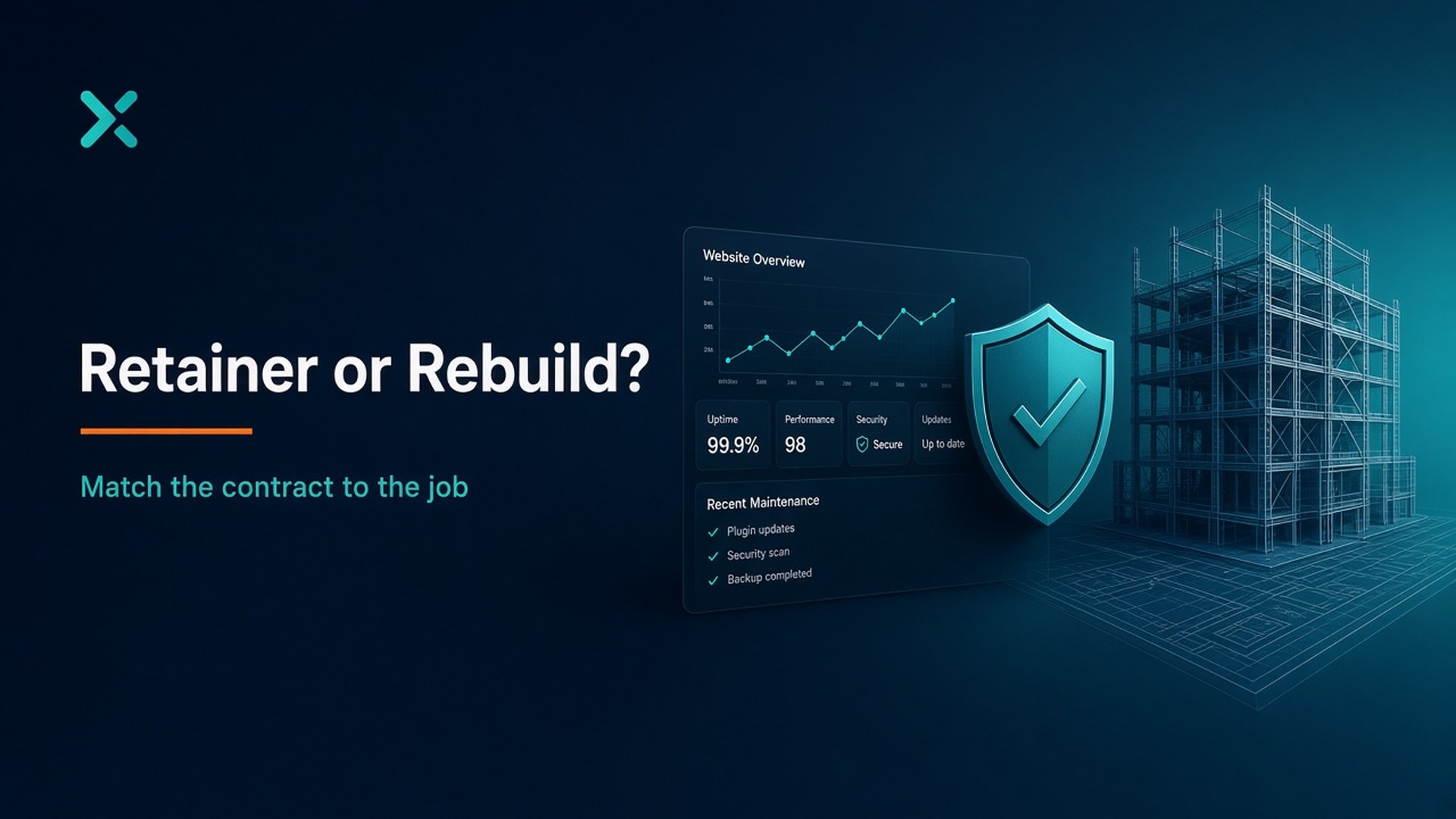
Buy a maintenance retainer when the job is ongoing care. Buy a rebuild when the bones must change. Security patches, backups, uptime, SSL, and light content edits belong on a recurring contract. A dead theme, unpatchable stack, UX that kills leads, or an information architecture that cannot carry your current offers belongs in a finite project — then care resumes after go-live. Mixing the two into one vague “maintenance” line item is how budgets stall and sites quietly rot.
Name the job before you renew the retainer
Founders often ask “Should we keep paying AMC?” when the real question is different. Force a one-line job name:
- Care job — Keep a workable site secure, backed up, lightly updated, and monitored.
- Skin job — Refresh look and UX on a platform that still patches cleanly (usually a redesign project, not unlimited retainer hours).
- Bones job — Replace platform, data model, or URL map so the site can carry 2026 offers.
- Hosting job — The server, not the theme, is failing (staging missing, disk full, repeated crashes).
- Ownership job — Keys live with a former developer; recover domain, hosting, and CMS admin before any contract.
If most of your pain is structural, another year of “unlimited tweaks” will not fix it. If the platform is healthy and you only need care, a rebuild project is overspend.
“A retainer is the caretaker. A rebuild is replacing the building. Do not buy one when you need the other.”
What a serious retainer includes — and what it does not
A credible maintenance retainer (sometimes called AMC) should read like operations, not marketing:
- Backups — Scheduled files + database, stored off the live server, with a restore test.
- Security updates — CMS, theme, and plugin patches on a stated cadence.
- Uptime monitoring — Alerts before customers tell you the site is down.
- SSL management — Renewals so browsers never flash “Not Secure.”
- Content quota — Written monthly allowance for text/image edits — not “unlimited redesign.”
- Support channel + response time — Named channel and SLA, not “we’re always available.”
- Monthly report — Uptime, backups taken, patches applied, changes made.
Usually not in a retainer (insist these are written as exclusions): full homepage redesigns, new features (payments, booking, portals), marketing copywriting, unlimited new pages, and deep hack cleanup beyond a stated incident SLA. Hosting fees belong in the quote only when explicitly bundled.
Signals that point to retainer vs rebuild
Score yourself honestly. Prefer a retainer when most answers land left; prefer a project when most land right.
- Site status — Loads and converts somehow, CMS still updateable → retainer. Broken theme, abandoned builder, “don’t update or it breaks” → project.
- Job this quarter — Keep secure and lightly edited → retainer. New IA, ecommerce, logins, or platform change → project.
- Security posture — Behind on patches but recoverable → retainer. Unpatchable stack or unknown code ownership → project (after ownership recovery).
- SEO / URLs — Keep current addresses → retainer. Must restructure paths or change domain → project with a redirect plan.
- Budget shape — Need predictable monthly care → retainer. Can fund a multi-week project, then attach care after cutover → rebuild + retainer.
“Fine but tired” is usually keep care on while you plan a project — not a reason to pause security for three months to “save money.”
“Pausing maintenance to fund a future redesign is how quiet security debt becomes an emergency rebuild.”
How to sequence care and a rebuild without double-paying chaos
When you need both, run them as a sequence, not a blur:
- Keep the retainer active through planning — patches and backups continue on the live site.
- Scope the project separately — deliverables, staging, content migration, redirect map, acceptance tests, go-live window.
- Name care hours vs project hours in the SOW so “maintenance” never silently becomes a redesign.
- Cut over once — migrate, verify forms/payments/tracking, then re-attach (or refresh) the retainer on the new stack.
- Do not rebuild without interim care if the old site still takes leads — neglect during a long build is a security bet.
Related decision: if the site is ageing and you are choosing redesign of the look versus rebuild of the stack, use a platform / data / URL diagnostic — that is a product choice, not a contract noun. Soft-read our redesign-or-rebuild guide when the bones are in doubt.
A one-week decision checklist
Before you sign or cancel anything this month:
- Confirm you hold domain, hosting, and CMS admin (or start ownership recovery now).
- List the last 90 days of incidents: downtime, hack attempts, failed updates, form outages.
- Write one sentence: care job, skin job, or bones job.
- Ask any vendor for inclusions, exclusions, response time, and a sample monthly report.
- If a rebuild is likely, keep the retainer on while you get a scoped project quote with staging and redirects.
Skip invented conversion targets. Use your own incident history and pipeline reality to decide.
Build for what comes next
Match the contract to the job. Keep a living site healthy with a clear retainer. When the platform or IA cannot carry the business, fund a scoped rebuild — then put care back on after go-live. That sequence protects leads, SEO, and security without paying twice for the wrong work.
TechyXen helps startups and SMBs ship web builds, hosting guidance, and ongoing care with clear scopes — not package gimmicks.
Web development ·
Cloud & DevOps ·
Contact ·
WhatsApp ·
Call

4 Comments
[…] Website maintenance retainer vs rebuild […]
[…] Website maintenance retainer or rebuild — choose the contract for the job you have […]
[…] Website maintenance retainer or rebuild — choose the contract for the job you have […]
[…] Put restores in the contract — if you pay for website care, the agreement should say who restores, how fast, and how often restores are tested (see maintenance retainer vs rebuild). […]