
A practical design guide for founders and ops leads buying WhatsApp automation — how to decide when a bot should stop, what the human needs on screen, and which reply metrics prove the handoff works before you add more automation.
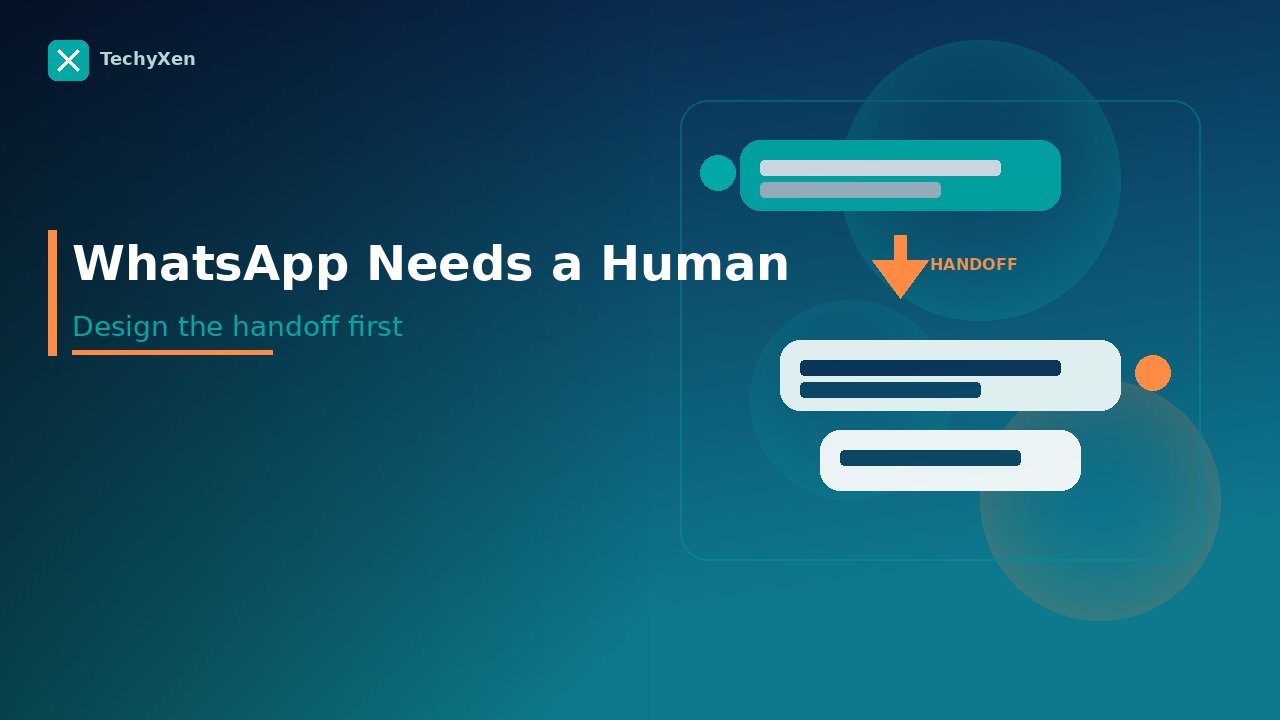
Most WhatsApp bots do not fail at greeting. They fail at the handoff. Design when a human takes over, what context that person must see in one screen, and how you will measure first reply, resolution, and reopen — then buy tools that fit that design. Automate the repeatable; staff the moments that burn trust.
What “automation” actually means on WhatsApp
On WhatsApp, “automation” is not one product. It is a stack of jobs that should be named separately before anyone quotes a bot license:
- Intake and routing — Capture the request, tag intent, and send it to the right queue or person.
- Catalog and FAQ answers — Price lists, hours, policies, and status lookups that do not need judgment.
- Transactional nudges — Order updates, appointment reminders, payment links, renewal prompts (with consent and template rules where the channel requires them).
- Qualification — Ask the few questions that decide fit, then stop — do not interrogate forever.
- Human conversation — Negotiation, complaints, exceptions, high-ticket advice, anything emotional or ambiguous.
If your brief still says “we need a WhatsApp bot,” you are shopping for a logo. Put intake, FAQ, transactions, qualification, or human desk on the scope first. The handoff sits between those jobs; it is not a feature you bolt on after go-live.
“Automate the repeatable. Staff the moments that burn trust.”
Where bots help — and where they burn trust
Bots earn their keep on high-volume, low-ambiguity turns: store hours, SKU availability, “where is my order,” booking slots, and collecting the three fields your CRM needs. They burn trust when they:
- Loop the customer — Same menu three times while the buyer is trying to explain an exception.
- Hide the human — No clear “talk to a person” path, or the path resets the conversation.
- Answer without grounding — Inventing policy, stock, or pricing the company cannot stand behind.
- Handoff cold — The agent opens a blank chat and re-asks everything the bot already collected.
- Stay in the chat too long — Complaints, refunds, and high-intent sales get a script instead of a named owner.
Published conversational-design guidance and platform docs keep repeating the same pattern: automation works when the exit to a human is obvious and context travels with the conversation. Treat that as design evidence, not a benchmark to invent.
Design the human handoff before you buy tools
Write the handoff as a product rule, not a vendor checkbox. Before you compare platforms, answer these on one page:
- Trigger — Which intents, keywords, sentiment, or failed bot turns force a human? Name them.
- Owner — Which queue or role receives the chat (sales, support, billing)? A name or rota, not “the team.”
- SLA — Target first human reply during business hours — and what the bot says when you are offline.
- Context pack — Exact fields the agent must see without scrolling three systems (see next section).
- Return path — After the human resolves, does the bot stay silent, resume for status updates, or close the thread?
- Escalation — When the first agent is stuck, who is next, and how is that recorded?
If you cannot fill that page, you are not ready to buy more automation. You are ready to buy a clearer ops design — then pick software that can enforce it.
“A bot that cannot hand off with context is just a polite way to lose the lead.”
Context the agent must see in one screen
Cold handoffs are where “AI on WhatsApp” quietly becomes a support tax. Design one agent view that shows:
- Who — Name, phone, CRM/account link, segment or deal stage if you have it.
- Why they are here — Detected intent + the last customer message in full.
- What the bot already did — Questions asked, answers given, buttons clicked, templates sent.
- Business truth — Order/ticket/appointment ID, payment or booking status, open issues — pulled from the system of record, not guessed.
- Risk flags — VIP, prior complaint, unpaid invoice, compliance note — anything that changes tone.
- Suggested next step — Optional: a short playbook line (“confirm refund window,” “offer callback”) that the human can ignore.
If the agent still needs three tabs and a spreadsheet to reply, the automation is unfinished. Fix the context pack before you add another FAQ flow.
Metrics that matter (first reply, resolution, reopen)
Skip vanity “messages automated” charts. Track a short scoreboard that proves the handoff works:
- Time to first human reply — After the handoff trigger, how long until a person sends a useful message (during staffed hours).
- Resolution on first human touch — Share of handed-off chats closed without a second ping-pong day.
- Reopen rate — Same customer, same issue, back within a defined window — signals hollow closes or missing context.
- Handoff abandon — Customer stops after the bot loop and never reaches a human (or leaves when told to wait).
- Bot containment with consent — Chats that truly finish in automation without the customer asking for a person — useful only when satisfaction or reopen stays healthy.
Use your own baselines for a quiet week, then a busy week. Do not paste industry averages you cannot verify. If first human reply is slow and reopen is high, buy staffing or routing clarity — not a bigger bot.
A one-week checklist before you buy more bots
Before you renew a BSP, add another AI layer, or expand intents:
- List the top ten WhatsApp intents from the last 30 days. Mark each: automate, qualify-then-handoff, or human-first.
- Write the handoff triggers and the offline message in plain language.
- Sketch the one-screen agent context pack; note which systems must sync.
- Sit with two agents for one hour each; watch where they re-ask what the bot already knew.
- Define the five metrics above and who reviews them weekly (a name).
- Ask any vendor how handoff, transcript history, CRM fields, and after-hours routing work — reject demos that only show happy-path FAQs.
- Pilot one intent with a hard exit to humans for 7–14 days before you widen the bot’s scope.
If the pilot improves first reply and cuts reopen without hiding the human path, expand. If not, fix design and staffing before you spend on more automation.
Build for what comes next
WhatsApp automation pays when it protects speed on the boring turns and protects trust on the hard ones. Design the handoff, the context pack, and the metrics first — then choose WhatsApp Business automation and AI that enforce that design. Tools follow ops; they do not replace it.
TechyXen helps startups and SMBs design and ship WhatsApp Business automation, AI assistants, and the CRM/workflow layer around them — with clear scopes, not package gimmicks.
Automation & AI ·
Web development ·
Contact ·
WhatsApp ·
Call

3 Comments
[…] WhatsApp automation still needs a human […]
[…] WhatsApp automation still needs a human […]
[…] WhatsApp automation still needs a human design the handoff before you buy bots […]